
Josias Berners c.1605 – 1661
“….. for since Josiah,
A forebear of our House, in London town
Did by his industry fresh lands acquire,
Large wealth from sire to son is handed down.”
Mary Alice Spencer Warwick. 1907

Josias Berners was born at the beginning of the seventeenth century, in the lifetime of William Shakespeare. Nicholas Kingsley has identified his year of birth as 1605. Josias was christened on 10th November 1605, at St Dionis Backchurch in the City of London. His name in the register is spelt as “Barnish”. This can be found in,“The reiester booke of Saynte De’nis, Backchurch parishe (city of London) for maryages, christenyges, and buryalles, begynnynge in the yeare of Our Lord God 1538”. His father, William, was a “silkman” and a member of the Draper’s Company. In 1620, aged 15 years, Josias was admitted to the Honourable Society of Gray’s Inn to train as a solicitor, following in the footsteps of his uncle, Robert. He later married Mary Cotton, youngest daughter of George Cotton Esq. of Panfield Hall, Essex.
Josias spent most of his life living in Clerkenwell, part of the current day Borough of Islington, in Middlesex. This area had a connection to the Berners family stretching back to Hugh de Berners (1086) who held 5 hides of land in gift from the Bishop of London.
In 1638, Josias took on the position of Clerk to the New River Company. He attended all weekly meetings and General Courts. He met and mingled with very wealthy, well-connected and influential people both within the New River Company and more widely. The position was salaried; the previous life holder was paid £100 per annum. Most importantly, the clerk could also be a shareholder of the company. Josias bought four “Adventurers” Shares from the Backhouse family; from Samuel one of the original investors in the New River scheme and his son, William. There were only 36 “Adventurers” shares altogether. In time, the shares were so lucrative that they were passed down through the Berners family for the next two hundred and fifty years.
Josias had Republican leanings, a strong belief in Parliament and was a strict Baptist. So, when the English Civil War began in 1642, he sided with Parliament and the Puritan cause.
Josias found himself in exactly the right place at exactly the right time. With his legal training and connections, he was placed in a supreme position to take advantage of what the chaotic times offered.
In January 1649 we find Josias at the epicentre of the Republican cause with his name being recorded, along with 134 others, against “An Act of the Commons of England Assembled in Parliament, for Erecting of a High Court of Justice, for the Trying and Judging of Charles Stuart, King of England”. In the Act itself: Be it Ordained and Enacted by the Commons in Parliament, and it is hereby Ordained and Enacted by Authority thereof, That Thomas Lord Fairfax, Oliver Cromwell, Henry Ireton, Esquires…Josias Berners…are hereby Appointed and Required to be Commissioners and Judges, for the Hearing, Trying, and Adjudging of the said Charles Stuart.”
While Josias’ name appears on the list of members of the High Court of Justice, he took no part in the trial and subsequent execution of King Charles, neither in the Painted Chamber or Westminster Hall, nor was he present when sentence was passed. However, Josias was described as one of the “outstanding officials of the Interregnum”.
Josias’ first wife, Mary, died in August 1652, without issue, and was buried in the church of St James, Clerkenwell. A monument was recorded there: Mary the Wife of Josiah Berners, Esq; Daughter of George Cotton, late of Panfield Hall in the County of Essex, Esq; 1652. Before the year was out, Josias married Abigail Lockey, the widow of John Lockey of Holmshill, Hertfordshire on 30th December. Abigail, daughter of Thomas Barnes, was co-heiress of the Aldborough Hatch estate, Essex.
On 21st March, 1654, Josias bought a small country farm of about 25 acres, comprising mostly fields, meadows and orchards off the old Tyburn Road. It was called Newlands. It cost £970 and proved to be the most remarkable investment.
The following year, his wife Abigail was delivered of a son, James, Josias’ son and heir, having previously lost a son, Thomas in infancy.
Later that year he was a member of Cromwell’s second parliament, elected as one of four MPs for Middlesex. Josias was clearly trusted and respected by the Protectorate governing body; indeed, he was part of it.
On 2nd January 1659, Josias was member of the Council of State along with General Monck, Lord Fairfax, Lord Warreston and others. At some point between May 1659 and October 1659, he held the position of Lord President of the Council of State. Josias struggled to keep Parliament, rather than the army, as the instrument of state. In December, he wrote urgent letters when General Monck’s army was converging on London and the apprentice boys were rioting, seeking to secure the Tower of London for Parliament.
Josias Berners’ will was dated 1st January 1660. Is this our Josias, buried a year later on 23 February 1661 in St Dionis Backchurch, the same church he was christened in? “Josias Barnars Esqr., a stranger”. As he had lived most of his life in Clerkenwell, is that why he was a “stranger”? St. Dionis Backchurch was destroyed in the Great Fire of London, any monument raised to him most likely was destroyed. In December of that year, or the year after, the papers and dates are muddled, a petition was made to Charles ll asking that John Wilford be appointed as clerk to the New River Company, “void by the death of Josias Berners.”
In his will Josias bequeathed his estate consisting of property in the City of London, Clerkenwell, Marylebone and Enfield, plus four shares in the New River Company, to his only son James. He also bequeathed £5 a year for apprenticing poor boys from Wormley, in Hertfordhsire.
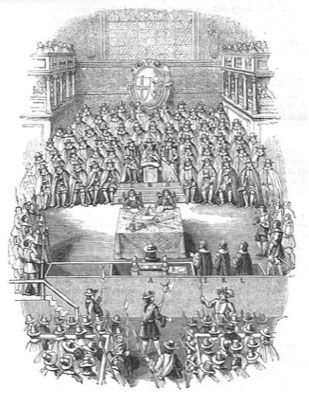
The Trial of King Charles 1 – 1649