
Parsonage
The Parsonage was probably built between the years 1870 and 1881. It was one of the two biggest houses in the village.

The Parsonage in Woolverstone is one of the later buildings erected in the village during the tenure of the Berners family. Sylvia Laverton states it was constructed at the turn of the twentieth century. The latest it can have been built was 1903 when Rev. Richard Utten Todd, the new curate and his wife moved in at the end of November that year. His stipend was £150 per annum. Perhaps it was earlier still. A Rev. Earnshaw, curate, was living at a Woolverstone Parsonage in 1885. It seems likely that the Parsonage was built in the same period as the construction of the Dairy, somewhere between 1870 and 1881. The 1886 Ordnance Survey map of Woolverstone shows the same footprint as the 1904 version. Furthermore, the 1886 map was surveyed five years earlier, in 1881. The Parsonage must have been in existence at this time.
The Parsonage was a large house set in ¾ acres, approached with a double entrance and with its own carriage drive. The drawing room and dining room both had bay windows facing south, one of each has since been removed. In addition: there was a service room, study, kitchen and scullery. On the first floor, there were four principal bedrooms and dressing rooms. Plus, a bathroom with a fireplace. Back stairs led to servants’ rooms, with attics above. There were cellars below. A tennis court and kitchen garden lay outside with coach houses.
When the Hall was sold in 1937, it was still the home of Rev. Utten Todd who died in 1962. There seems to have been a period when building was left to deteriorate before the parsonage was sold in July 1964, “In need of renovation”.
The Parsonage was bought by Stuart and Peggy-Ann Munroe in 1964. Their son, Alex, who grew up there, describes it in his book “Two Turtle Doves” (Bloomsbury. 2014). His parents, “found The Old Parsonage off the main road in Woolverstone, an odd strung-out kind of village, with a school and a post office but no pub. The house was falling apart. It was the biggest in the village, with the exception of Woolverstone Hall, which at that point was the London County Council boarding school. The garden of The Old Parsonage led down towards the river Orwell, and it was a short sail from there to Pin Mill.
As well as the many staircases, it had umpteen rooms. Along the eastern side they all interconnected on the first floor through a series of little ante chambers, so a small boy could hide almost anywhere. There were attics, cavernous cellars, drawing, sitting and dining rooms, halls, a school, a forge, stables, garages and I don’t know what else. Ever since the department of the parson at the turn of the century the house had been left to crumble bit by bit. By the time my parents arrived, the gardens were far from spectacular, the tennis courts were used as goose pens, green houses had sagged and cracked, and the orchards were long-legged and overgrown.”
“Two Turtle Doves”. Alex Monroe. 2014. Bloomsbury.
In 1984, the Old Parsonage was bought by a Mr Glasher and converted to a care home (First Class Homes (Spring Lodge) Ltd.) The orchard was sold to a neighbour. It has remained a Care Home until this day and has been, over time, altered and extended considerably. Kingsley Healthcare are the current owners.
The Parsonage was mostly home for the Curate at Woolverstone while the Rector maintained a more fitting Rectory at Erwarton. Reflecting the importance of the clergy, this was a much grander house.
In total, John Berners spent an estimated £80,000 on this Great Transformation of the Woolverstone Park estate.

The Parsonage – 1964
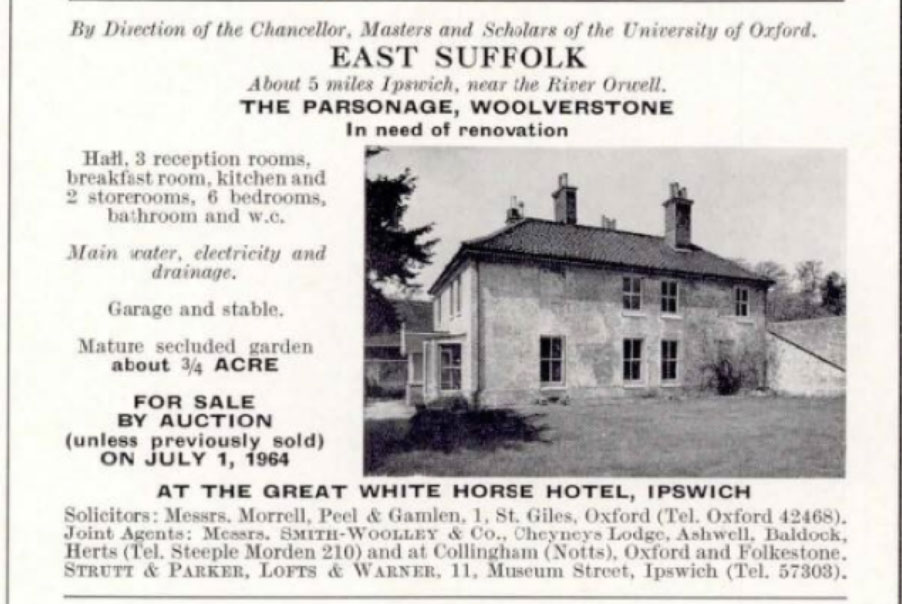
Country Life – 18th June 1964